Client story · Nonprofit · Springfield, Oregon

Power On With Limb Loss: easier to find, and easier to run.

Power On connects amputees and people with limb difference to peer visitors, monthly support groups, and adaptive activities across Oregon. Through The Fotizo Method, we rebuilt the website, gave each core program and event its own front door, brought every request into one place, and made the peer visit program easier for Paula to see and run.

★★★★★ “They are on time with their work and a pleasure to work with!” Paula Free, Founder, Power On With Limb Loss, Google review
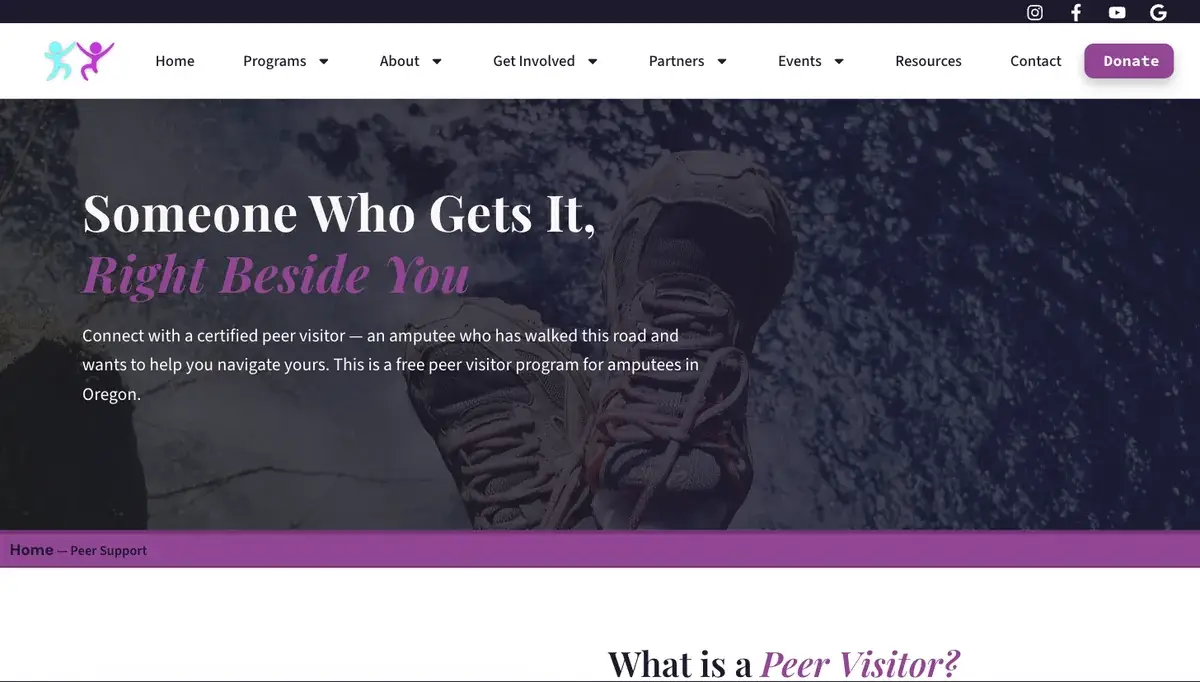
poweronwithlimbloss.org/amputee-peer-support-oregon
Power On With Limb Loss peer support page on desktop: Someone who gets it, right beside you
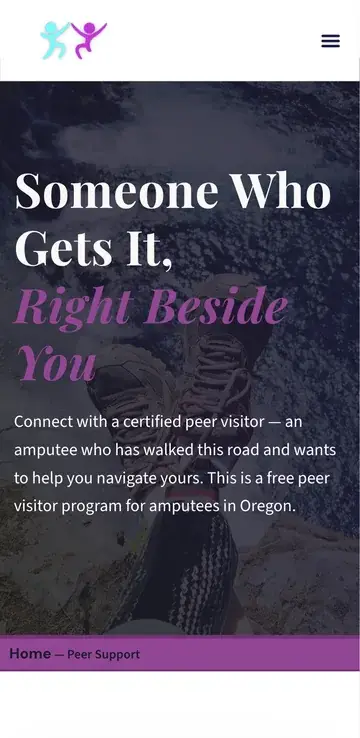
The same page on a phone
poweronwithlimbloss.org · built by Fotizo Media
Organization
Peer-led nonprofit for amputees and people with limb difference
Where
Springfield, Oregon, with support groups in Eugene, Salem, and Portland, plus virtual meetings
Programs
  • Peer visits
  • Monthly support groups
  • Adaptive activities
  • The annual Discover Conference
  • A Women’s Retreat
Engagement
The Fotizo Method, since late February 2026
We built
  • Nonprofit website
  • Five program forms into one CRM
  • Conference registration and email sequence
  • Peer visit log and reporting sheet
  • Search and AI visibility

The situation

A full year of programs, and one person keeping track.

Before
  • A Squarespace site losing visitors.
  • Forms connected to no CRM.
  • Peer visit reports gathered by hand.
Now
  • A page for every program.
  • Five forms into one contact system.
  • A peer visit log that keeps the program in one place.

Power On With Limb Loss is peer-led: its certified peer visitors are amputees themselves, and they meet with people facing or recovering from amputation at hospitals and clinics, or by phone. Monthly support groups meet in Eugene, Salem, and Portland. Adaptive activities, the annual Discover Conference, and a Women’s Retreat fill out the year.

When founder Paula Free brought us in, the website was a Squarespace site whose visits had fallen 17% from 2024 to 2025. Its forms weren’t connected to any CRM, so keeping track of who asked for what fell to Paula. Power On’s Mailchimp list had grown the way most small lists do, a tag at a time as needs came up, so it was hard to tell who belonged to which program.

Peer visits were the hardest part to follow. Visits were reported to the Amputee Coalition one visitor at a time, so the whole program was never in one place. Paula often gathered the details herself to make sure every visit counted.

The visits were happening. They just weren’t easy to see.

The approach

What we recommended, and why.

  1. Give every program its own front door.

    One general contact form makes the founder the switchboard: every message has to be read, sorted, and passed along by hand. A form for each program and event lets the system do the sorting. A conference registrant lands in the conference list, and a Women’s Retreat registrant in the retreat list, the moment they hit submit.

  2. Keep every relationship in one place.

    At a small nonprofit, the same person is often a volunteer, a donor, and a conference guest. Separate tools split that person into three strangers. One contact record per person lets Paula see the whole relationship before she picks up the phone.

  3. Make the report a byproduct of the visit.

    Volunteers give their time to the visit itself, so the paperwork afterward should take as little of it as possible. We built the log for a phone and about two minutes, and built every total and report to fill in from what’s saved, so Paula has the full picture without having to ask for it.

  4. Build for the way people search.

    Someone looking for help types “amputee support group” whether they live in Portland or Boise. We wrote each program page around those searches.

The work

What we built.

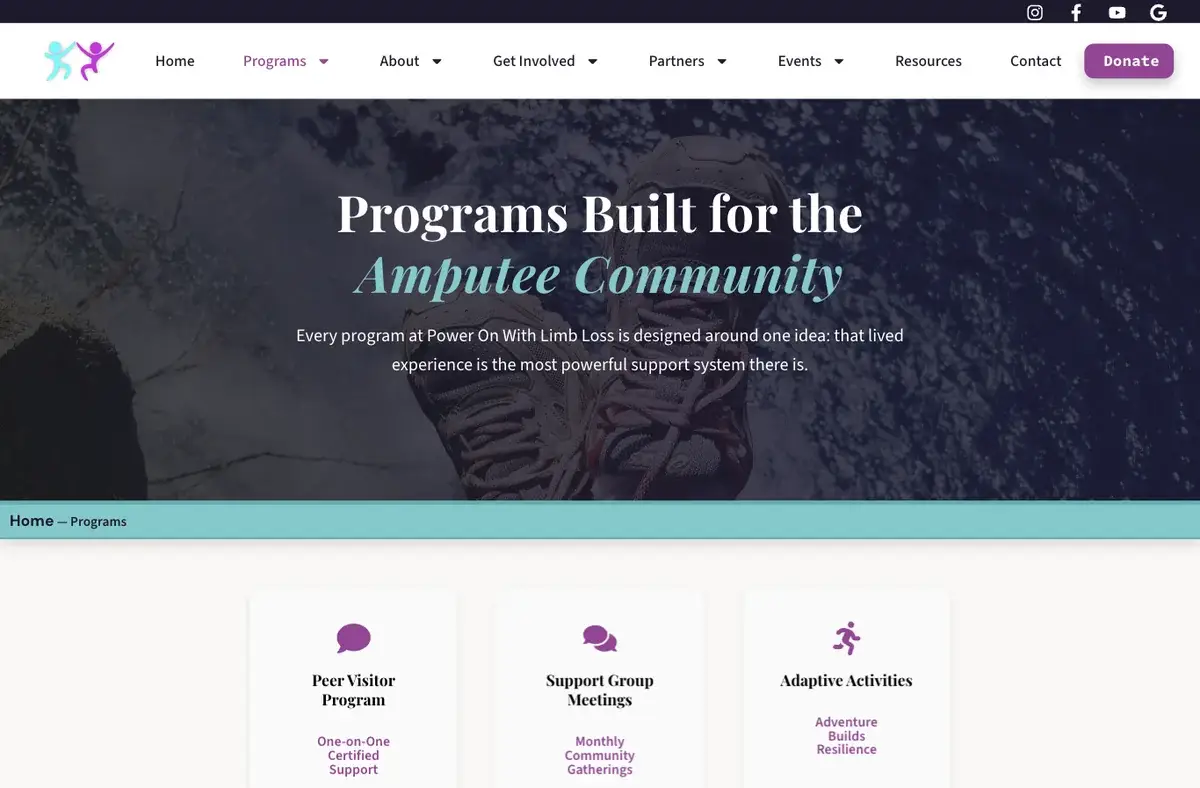
poweronwithlimbloss.org/amputee-programs
Power On’s programs page on desktop: Programs built for the amputee community, with peer visitor, support group, and adaptive activities entries
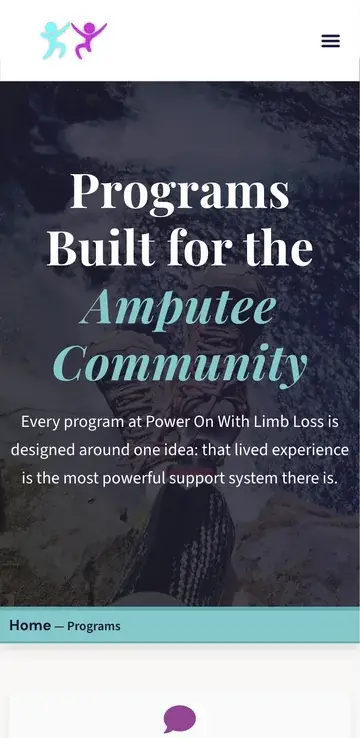
The programs page on a phone

Website

A nonprofit website redesign built around the programs.

We moved Power On from Squarespace to WordPress and organized the site around what people come for: peer support, support groups, adaptive activities, the conference, and giving. The old site’s main addresses forward to their new pages, so saved links and bookmarks still land in the right place. Power On owns the domain, the site, and every account behind it, and we manage them on its behalf.

Business systems

Five front doors, one contact system.

Conference registration, support group sign-ups, peer visitor requests, Women’s Retreat registration, and general questions each have their own form. Every submission lands in Power On’s GoHighLevel CRM, one contact system with a record for every person, filed under the form it came through. Between March and October 2026, those five forms brought in 150 requests.

Events

Registration and reminders for the 10th Discover Conference.

Power On’s largest event of the year needed a registration path before it needed anything else. An eight-email countdown kept registrants informed, from the registration confirmation to a “Today’s the day” email the morning of the conference. By late April, 62 people had registered, and 24 of them had offered to volunteer. The form has now taken 93 sign-ups, a few of them already for next year.

An urgent flag on any log sends Paula a separate alert right away.

Peer visits

A quicker log for visitors and a clear view for Paula.

After each visit, a certified peer visitor opens the password-protected Peer Visitor Hub on their phone and fills out a short log: when, how long, how they connected, and what came up. Everything after that happens on its own: the note on the person’s record, the row on Paula’s sheet, and her email summary.

For Paula, it’s a view of the program she hasn’t had before. She can stay current on who has received a visit, get 60 days’ notice before a peer visitor is due for recertification, and watch the program grow month by month. A dashboard on the same sheet totals visits, people reached, and volunteer hours for any month, quarter, or grant period, so grant reports start from numbers that are already there. Each month’s Amputee Coalition report comes together on its own, ready to send.
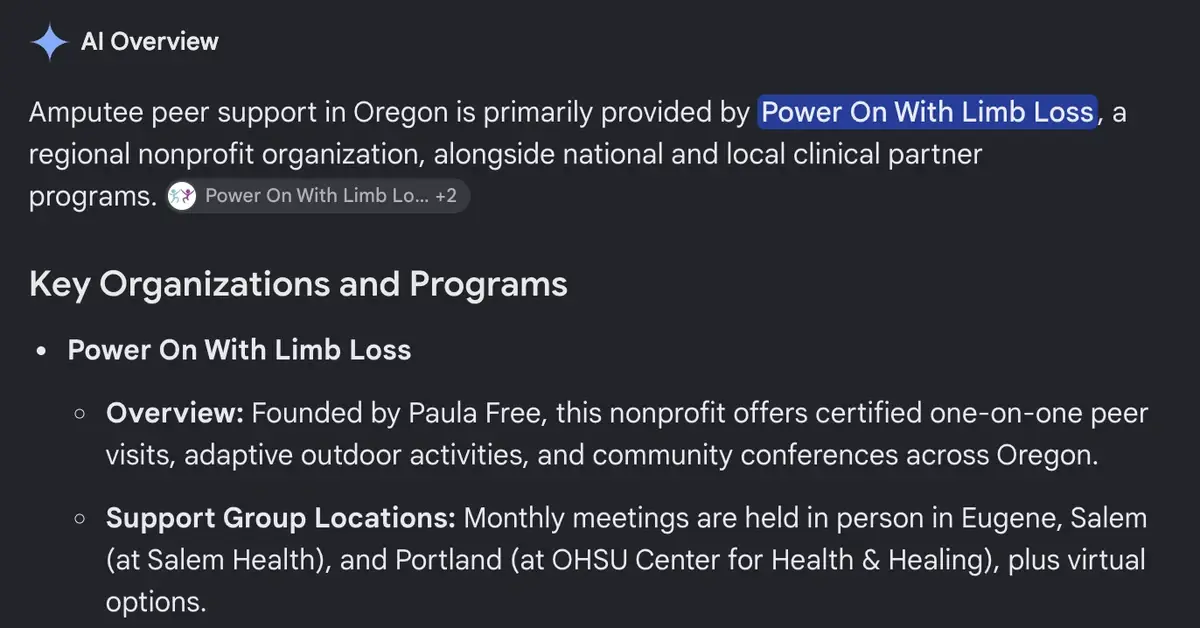
google.com/search?q=who+provides+amputee+peer+support+in+oregon
Google AI Overview for who provides amputee peer support in oregon: Amputee peer support in Oregon is primarily provided by Power On With Limb Loss, a regional nonprofit organization, alongside national and local clinical partner programs. Power On With Limb Loss is listed first under key organizations and programs.
Google’s AI Overview for “who provides amputee peer support in oregon,” October 2026. Image results hidden. Results vary by location.

Nonprofit SEO and AI search

Found well beyond Oregon.

We tuned Power On’s Google Business Profile, matched each program page to the searches behind it, and added structured data, so search engines and AI tools read the organization, its events, and its programs correctly. Setting aside searches for Power On by name, about 84% of its Google appearances come from searches with no Oregon place in them, like “amputee support” and “programs for amputees.” Google’s AI Overview for “who provides amputee peer support in oregon” says peer support in Oregon is “primarily provided by” Power On.

The engagement

The Fotizo Method, in order.

The Fotizo Method starts with an evaluation, sets goals, and builds the plan in order of impact. For Power On, impact and the calendar agreed: the 10th Discover Conference was May 2, so registration came first.

  1. Late February into March

    The evaluation.

    We reviewed the old site page by page, then the email list and Power On’s search presence.

  2. By early March

    The goals and the plan.

    Conference registration first, because it had a deadline. Then a site that matched the programs, and one place for every relationship.

  3. March

    The first build.

    Conference registration opened in early March. The new site launched mid-month.

  4. May 2

    The 10th Discover Conference.

    The first big event to run through the new system.

  5. Summer and fall

    The ongoing partnership.

    Search and AI visibility work, Women’s Retreat registration, and a peer visit log that files each visit as it’s saved.

Results so far

What’s measurable so far.

Numbers as of October 2026, seven months after the new site launched.

150

program requests through Power On’s five forms since March

#1 & #2

organic Google results for “amputee support group oregon” are Power On pages (October 2026)

990

times Google showed Power On’s pages in its AI-generated answers, May to October 2026

41

states, plus Washington, D.C., that sent engaged visits to the site

Map of the United States with 41 states and Washington, D.C. litStates that sent one or more engaged visits since March are lit warm, brightest in Oregon. Not yet lit: Alaska, Louisiana, Maine, Mississippi, Montana, Nebraska, Rhode Island, South Dakota, and Vermont.

Lights across the country.

52% of engaged visits came from outside Oregon. States with engaged visits, March to October 2026. Source: Google Analytics.

The conference brought the first wave of visits. After it passed, discovery climbed to its high in August. Leaving the conference page out, so the event’s own traffic doesn’t skew the trend, Power On appeared in Google results about 25% more often per month from June through September than in April and May.

The search, AI, and map figures are leading signals. They show that people looking for help can find it. For a nonprofit, the scoreboard is people reached: requests received, visits made, families in the room. Requests are the first figure above. Peer visit totals join them after a full season of logs.

Requests: Power On’s CRM, March to October 2026, test entries excluded (93 conference, 22 support group, 19 general, nine retreat, seven peer visit requests). Search results: Google, searched in October 2026 from the Eugene area; results vary by location. AI answers, search trend, and the 84% (share of non-branded appearances on the queries Search Console reports): Google Search Console. States: Google Analytics, engaged sessions.

Our services

The work behind this story.

This project brought three of our services together under The Fotizo Method, our ongoing partnership: website design built around how people use the site, business systems that gather requests and handle the paperwork, and local SEO that helps people find the help nearest them. Each is also available on its own.

The first conversation

Tell us what you’re working on. We’ll respond with thoughts, not a pitch.

Whether you run programs, events, or a team of volunteers, tell us where requests and reports get stuck today and we’ll tell you what we’d build first.

Tell us what you’re working on

No contracts. Your assets stay yours.